7 Deadly Sins Test

7 Deadly Sins Test

Rate 28 everyday statements and get a score for every sin: pride, envy, wrath, sloth, greed, gluttony and lust. About three minutes, free, no sign-up and nothing to install.

28 statements, 7 scores, 1 strongest sin

Which of the seven has the strongest hold on you?

About three minutes. Your answers stay on your device; only your seven scores are counted, anonymously.

Opening the 7 deadly sins test…

Share on

What is the 7 deadly sins test?

The 7 deadly sins test is a short personality quiz built on the oldest list of human failings in Western culture: pride, envy, wrath, sloth, greed, gluttony and lust.

Instead of putting you in a single box, this seven deadly sins test scores all seven. You see your strongest sin, your runner-up and the ones that barely register. Every statement describes something ordinary: a snoozed alarm, someone cutting in line, a group project, a message left on read, a series you keep watching long after you meant to stop.

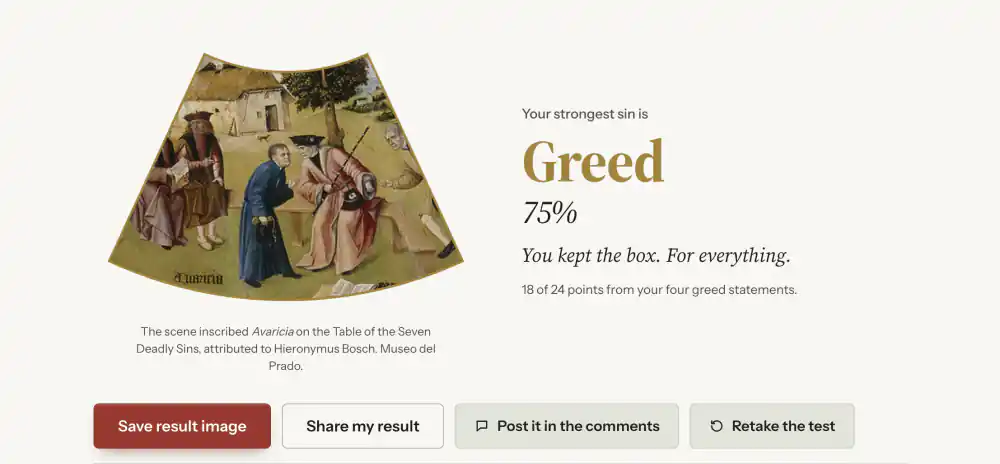
Example 7 deadly sins test result: greed is the strongest sin at 75%, shown with Bosch's painting of greed and the buttons to save or share the result
A real result from the 7 deadly sins test: your strongest sin, its percentage, the points behind it and the painting that goes with it.

You rate how much each one sounds like you, and the 7 deadly sins test turns your answers into seven percentages, a radar chart of all seven and a result image with the painting of your strongest sin.

It is made for fun and honest self-reflection. It is not a religious exam, not a clinical assessment and not a character quiz for the anime The Seven Deadly Sins. Your individual answers stay on your device unless you choose to share them.

How the 7 deadly sins test works

  1. 1

    Rate 28 statements

    Four statements belong to each sin. They are mixed so the same sin never comes up twice in a row, which makes it harder to guess what is being measured.

  2. 2

    Pick one of seven answers

    Answer from “Not me at all” (0 points) to “Exactly me” (6 points). “Not sure” sits in the middle.

  3. 3

    Get seven scores

    Each sin can earn 0 to 24 points. Your percentage is your points divided by 24, so scores move in steps of about 4%.

  4. 4

    Settle a tie

    If two or more sins share the top score, one last question asks which line sounds more like you. That choice decides your strongest sin; your percentages stay the same.

Worked example. You answer the four wrath statements with 5, 6, 4 and 5 points. That is 20 of 24 points, so wrath scores 83% on your 7 deadly sins test.

The seven deadly sins, in order

The order is the one Dante climbs in Purgatorio, from pride at the foot of the mountain to lust near the top. Each sin has a traditional opposite virtue, and your result names the one that answers your strongest sin.

Around 1500, a painter in the Low Countries set the seven sins in a wheel of small everyday scenes: a fight outside a farmhouse, a nap by the fire, a judge taking a bribe. Turn the wheel to read each one.

IPride

Drag the wheel or tap a painting

I

Pride Superbia

Needing to be right, admired and never the one who asks. The upside: high standards and the nerve to back yourself.

In the painting, a woman tries on a new headdress in front of a mirror that a demon holds up for her.

Answered by humility

II

Envy Invidia

Keeping score of other people's lives, and losing. The upside: it points straight at what you really want.

In the painting, a couple at their door stare after a gentleman with a falcon, and two dogs ignore the bones on the ground to eye the one in their master's hand.

Answered by kindness

III

Wrath Ira

Anger that moves faster than you do, and a long memory. The upside: you care about fairness and stand up for people.

In the painting, two men fight outside a farmhouse. One wears a stool on his head; the other raises a blade while a woman tries to hold him back.

Answered by patience

IV

Sloth Acedia

A heaviness that makes starting anything feel hard. The upside: easygoing, and you rarely trample anyone to get ahead.

In the painting, a man dozes by the fire with his dog asleep on the floor, while a nun holds out a rosary to call him back to his prayers.

Answered by diligence

V

Greed Avaritia

Wanting more and holding on tight, just in case. The upside: careful, prepared and good with value.

In the painting, a judge listens to one man's case while taking a bribe from the other behind his back.

Answered by generosity

VI

Gluttony Gula

Going past enough: food, screens, shopping, one more of anything. The upside: a real love of comfort, and of sharing it.

In the painting, a heavy man eats while another drinks straight from the jug, a woman carries in another roast and a small child clings to the father for a share.

Answered by temperance

VII

Lust Luxuria

Craving intensity, excitement and attention right now. The upside: a big capacity for delight.

In the painting, couples flirt in and beside a tent, with wine, fruit and musical instruments on the grass, while a fool gets a beating nearby. More on the sin of lust

Answered by self-control

Paintings: details of The Seven Deadly Sins and the Four Last Things, attributed to Hieronymus Bosch or a follower, about 1505–1510, oil on panel. Museo del Prado, Madrid. Public domain, images via Wikimedia Commons. The Latin names above are the standard ones; two scenes are inscribed with the older spellings Accidia and Avaricia.

What your 7 deadly sins test result shows

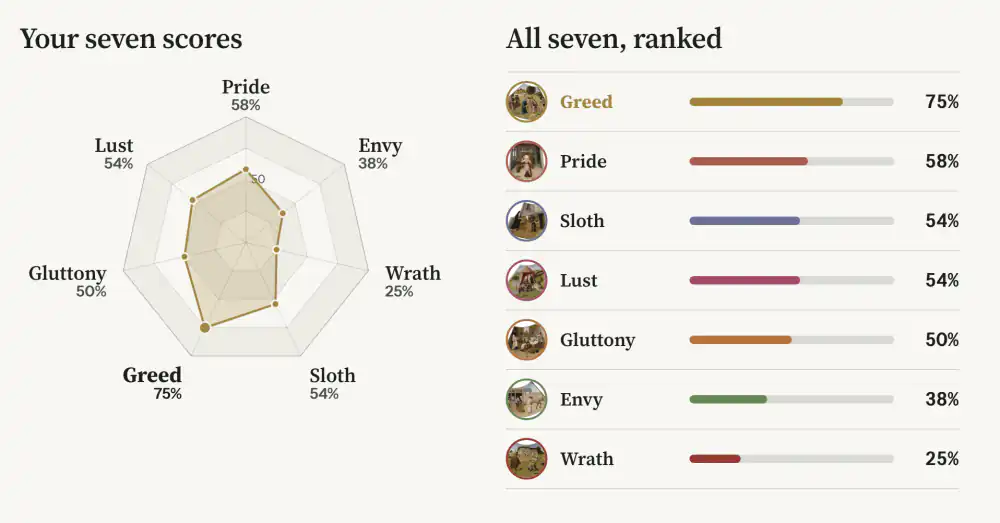
Example 7 deadly sins test scores: a radar chart and a ranked list of all seven sins, from greed at 75% down to wrath at 25%
Every result scores all seven sins: a radar chart for the overall shape and a ranked list with exact percentages.

Your strongest sin

Its percentage, the points behind it, a one-line verdict and the painting that goes with it. If two sins tie, the tie-break question decides.

All seven, ranked

A radar chart of all seven scores, and every sin listed from highest to lowest. Once enough people have finished, you also see how each score compares with everyone else here.

What it means

A plain reading of your top two sins, the virtue that answers your strongest one and three small things to try this week.

Share and compare

Save a 1080 × 1920 image for TikTok or Instagram Stories, or post your link to X, Facebook, WhatsApp, Reddit, Telegram or Threads. A friend who finishes the test sees both results side by side, with what you share and where you differ most.

How to read your 7 deadly sins test scores

ScorePointsWhat it means
0–25%0–6This sin rarely shows up in how you act.
29–50%7–12It appears now and then, usually under pressure.
54–75%13–18A clear habit that friends would probably recognise.
79–100%19–24A strong pull, usually your top sin or close to it.

Scores show how strongly a habit came through in your answers, not how good or bad a person you are. Low scores across the board are a real result too: none of the seven has much of a hold on you right now, or you were generous with “Not me at all”.

How accurate is the 7 deadly sins test, and what can it not tell you? All 28 statements, what each sin’s four cover and the test’s limits.

Questions about the 7 deadly sins test

Is the 7 deadly sins test completely free, or are there paid features?

It is completely free, and there are no paid features. Nothing is locked: all seven scores, the radar chart, the reading of your top two sins and the result image are free for everyone, and there is no premium report to buy. You do not need an account or an email address. The site may show ads to cover its running costs.

Do I need to create an account or download anything?

No. There is no account, login or email step, and nothing to download or install. Open deadlysinstest.org in any web browser, press Start and rate the 28 statements. Your result appears as soon as you rate the last one.

Can I take the test on my iPhone or Android phone?

Yes. Open deadlysinstest.org in Safari, Chrome or any other browser on an iPhone, iPad or Android phone and tap Start. There is no app: the test runs in the browser and works the same way on a computer or tablet. The result image is sized for phone stories.

How long does the 7 deadly sins test take?

About three minutes. There are 28 statements and you tap one of seven answers for each. If you leave halfway, your progress stays saved in your browser so you can finish later on the same device.

Is there an official 7 deadly sins test?

No single version is official. The list of seven deadly sins goes back to Pope Gregory the Great in the 6th century, so nobody owns the idea, and several websites publish their own version with different questions and scoring. This one, at deadlysinstest.org, is independent: 28 original statements, all seven sins scored as percentages and the whole scoring method published on the How accurate page.

Can I retake the test?

Yes, as often as you like and straight away. Press "Retake the test" on the result page. That clears the result saved in your browser and starts a fresh attempt, so save the result image or copy your result link first if you want to keep the old one.

What do the different results mean?

Your result is the sin with the highest score, and each one stands for an everyday habit that also has an upside. Pride: needing to be right and noticed, along with high standards and self-belief. Envy: comparison that stings, which often points to what you really want. Wrath: quick anger, usually from caring about fairness. Sloth: a heaviness that makes starting hard, though you rarely trample anyone to get ahead. Greed: holding on tight in case you run out, which also makes you careful with value. Gluttony: going past enough with food, screens or shopping, out of a real love of comfort. Lust: craving intensity and excitement, with a big capacity for delight. Your result page explains your top two sins in more detail.

How accurate is the 7 deadly sins test?

It reflects what you report about your own habits, so honest answers give the clearest picture. The scoring is fully open: each percentage is the points you gave a sin's four statements divided by 24. It has not been scientifically validated, so it is for fun and self-reflection, not a psychological diagnosis. After every result you can tell us whether it felt right, which helps us replace statements that miss. The How accurate page lists all 28 statements and the test's limits.

Why did my result change when I retook it?

The test records how you rate the statements on the day, so your mood and what happened recently can shift your answers. Each sin has only four statements, so moving one answer from "Not me at all" to "Exactly me" changes that sin's score by 25 percentage points. Some change between two attempts is normal.

Can I see my result again later?

Yes, on the same device and browser. Your last result stays saved until you retake the test or clear this site's data. To keep it for good, save the result image or copy your result link.

Is the test religious?

No. The list of seven sins comes from Christian tradition, but every statement in this seven deadly sins test is about an everyday habit such as snoozing an alarm, keeping a grudge or ordering more food than you can finish. None of them ask about faith.

Is this a Seven Deadly Sins anime character quiz?

No. This test is about the seven deadly sins of tradition, scored from your everyday habits. It does not match you with characters from the anime The Seven Deadly Sins.

Are there sexual questions in the lust section?

No. In this test, lust is scored as craving intensity, excitement and attention, so it is easy to take with friends.

What are the 7 deadly sins in order?

Pride, envy, wrath, sloth, greed, gluttony and lust. This is the order of the terraces in Dante's Purgatorio, from pride at the bottom to lust near the top.

Which of the seven deadly sins is the worst?

Christian tradition usually names pride. Pope Gregory the Great called pride the root of the other sins. In this test, pride is scored the same way as every other sin, by its own four statements.

What are the opposite virtues of the seven deadly sins?

Pride is answered by humility, envy by kindness, wrath by patience, sloth by diligence, greed by generosity, gluttony by temperance and lust by self-control. Your result names the virtue that answers your strongest sin.

Where do the paintings come from?

They are details of The Seven Deadly Sins and the Four Last Things, a painted tabletop attributed to Hieronymus Bosch or a follower, made around 1505 to 1510 and now in the Museo del Prado in Madrid. Each sin is a small scene from everyday life, labelled with its name in Latin. The painting is in the public domain, and the images come from Wikimedia Commons.

Is this the same test that is going around on TikTok?

No. The result charts people are posting on TikTok come from a different website. This test is independent: 28 original statements, a seven-point scale and a tie-break question, with all seven scores shown as percentages.

Can I share my result and compare with friends?

Yes. Save your result as a 1080 by 1920 image for TikTok or Instagram Stories, post your link to X, Facebook, WhatsApp, Reddit, Telegram or Threads, or copy it. When a friend opens the link and finishes the test, they see both results side by side, including what you share and where you differ most.

Is the test available in other languages?

Not yet. The 7 deadly sins test is in English only for now.

Does the test store my answers?

Your individual answers are saved only in your own browser, unless you choose "Share my answers anonymously" on the result page to help us improve the statements. When you finish, your seven scores are counted anonymously, without your answers or any personal details, so everyone can see how their result compares. A result link you share contains your seven scores and nothing else.
Sources

  • Gregory the Great, Moralia in Job (late 6th century). The list of seven capital sins that later writers followed, with pride as their root.
  • Prudentius, Psychomachia (around 400). An early poem in which virtues fight the vices, the source of the idea that each sin has an opposite virtue.
  • Dante Alighieri, Purgatorio (early 14th century). The seven terraces of the mountain, in the order this test uses.
  • The Seven Deadly Sins and the Four Last Things, attributed to Hieronymus Bosch or a follower, about 1505–1510. Museo del Prado, Madrid.

What did you get?

Post your strongest sin and its percentage. Was it the one you expected? comments