VII The seventh deadly sin · Luxuria
Lust sin: the seventh deadly sin explained
The lust sin, or the sin of lust, is desire that has slipped its leash: wanting pleasure, above all sexual pleasure, in a way that takes over instead of serving love. It is the last of the seven deadly sins in the usual order, and the old writers treated it as the least grave of the seven, but also one of the hardest to shake.

- Latin name
- Luxuria
- Place in the list
- Seventh of seven
- Opposite virtue
- Chastity, or self-control
- Dante's terrace
- Seventh, a wall of fire
- How grave
- The least grave of the seven
What the sin of lust means
In Christian tradition, lust is disordered desire. The problem is not attraction or pleasure as such, which most teachers see as good, but desire that ignores the other person, ignores commitments and keeps asking for more. Thomas Aquinas placed lust under temperance, the virtue of keeping pleasure in proportion, and listed eight "daughters" it tends to produce.
Aquinas: the eight daughters of lust
- Blindness of mind
- Thoughtlessness
- Inconstancy
- Rashness
- Self-love
- Hatred of God
- Love of this world
- Despair of the world to come
From the Summa Theologiae, II-II, question 153. Most are about what lust does to judgement, not to the body.
Most Christian teachers also draw a line between noticing or feeling attraction and choosing to dwell on it or act on it. The lust sin is located in the second, not the first.
Where the word comes from
The earliest lists of deadly thoughts come from the desert monks, and the name of this sin changed twice on its way into English.
- Late 4th centuryEvagrius PonticusporneiaOne of eight "evil thoughts" named by a desert monk.
- Early 5th centuryJohn CassianfornicatioCarries the eight into Latin for monks in the West.
- Late 6th centuryGregory the GreatluxuriaReshapes the list into the seven capital sins.
- TodayEnglishluxuryThe same Latin word, still meaning more than you need.
In classical Latin, luxuria meant excess and extravagance, too much of a good thing. The English word "luxury" comes from it. That older sense still fits: lust is appetite that has grown past what it is for.
What the Bible says about lust
Three passages are quoted more than any others when people ask what the Bible says about lust.
Matthew 5:27-28In the Sermon on the Mount, Jesus says that looking at someone with lustful intent is already adultery in the heart.
Galatians 5:19-21Paul puts sexual immorality first in his list of the "works of the flesh".
1 John 2:16"The lust of the flesh" and "the lust of the eyes" are named as things that do not come from God.
The seven deadly sins as a list are not in the Bible; they were drawn up later from passages like these.
Lust in Bosch's painting
On the painted tabletop attributed to Hieronymus Bosch, now in the Museo del Prado, the scene labelled Luxuria is not graphic. Bosch shows the setting of lust, idle pleasure and easy company, and a fool hints at where it leads. Look for these five details:
- Two couples, one standing inside the red tent and one sitting at its entrance.
- A little table set with a jug of wine and a dish of food.
- Musical instruments left lying on the grass.
- A fool in a jester's costume, sprawled on the ground and being beaten.
- The word luxuria, Bosch's Latin label for the scene.
Lust in Dante's Purgatorio
Dante places lust on the seventh and highest terrace of the mountain of Purgatory, closest to the Earthly Paradise, because he sees it as the least grave of the seven: love aimed at a good thing, but too much of it. The souls there walk inside a wall of fire, singing a hymn and calling out examples of chastity, and two groups pass each other with a brief kiss of greeting (Purgatorio 25-27). Dante himself has to walk through the flames before he can go on, and only agrees when Virgil reminds him that Beatrice is on the other side.
The opposite virtue: chastity and self-control
The traditional virtue that answers the sin of lust is chastity, which does not mean having no desire. It means desire that is honest, faithful and kept in proportion, whether a person is married or not.
Lust
The sin- Desire that takes over
- Uses the other person
- Ignores commitments
- Wants more, and wants it now
Chastity
The virtue, often called self-control- Desire kept in proportion
- Respects the other person
- Honest and faithful
- Able to wait
Because Aquinas treats chastity as part of temperance, many modern lists simply say self-control. On this site's test, the virtue named for a high lust score is self-control.
How lust shows up in everyday life
The 7 Deadly Sins Test on this site does not ask sexual questions. It reads lust in the wider sense of craving intensity: falling for things fast, getting restless when life is calm, wanting the good feeling now. These are its four statements, each rated from "Not me at all" to "Exactly me":
I fall for people, places or hobbies fast and all at once.
Quiet, predictable days make me restless.
A new crush can take over my thoughts for days.
If something feels good right now, "later" doesn't feel real.
People who score high here usually have a real capacity for delight and enthusiasm. The work is not to switch that off, but to let excitement serve the people and projects you care about instead of replacing them. Three small ways to practise:
- Spend one evening doing something quiet on purpose.
- Wait a day before buying or starting the next exciting thing.
- Finish one project before you start a new one.
Find out how strong lust is in you
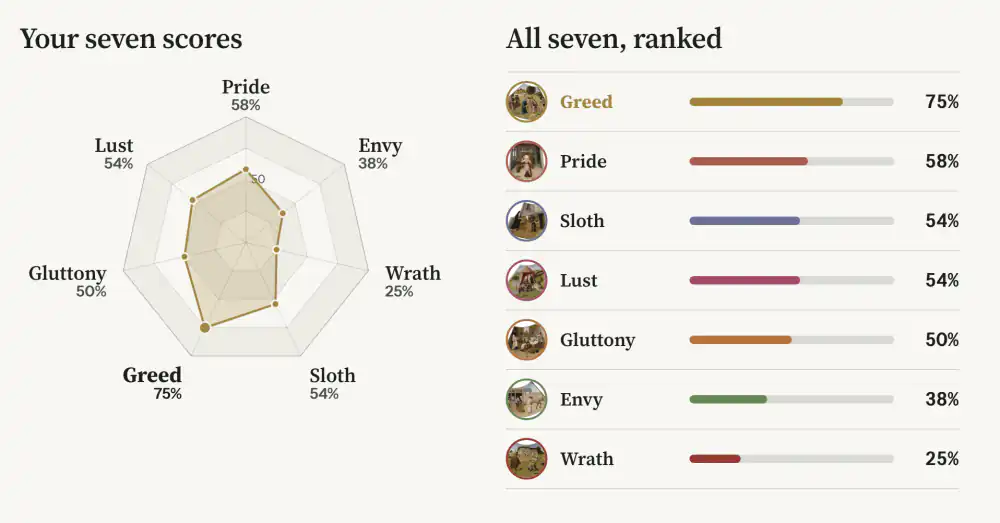
The free 7 Deadly Sins Test scores lust alongside the other six sins in about three minutes, with no sign-up, and shows all seven as percentages on a radar chart.
How the score is worked out: How accurate is the test?
Questions about the lust sin
Is lust the worst of the seven deadly sins?
No. Tradition usually names pride as the worst and lust as the least grave of the seven, which is why Dante puts it on the highest terrace, nearest to paradise. It is still counted as a deadly sin because it can take over a life.
Is being attracted to someone a sin?
Most Christian teachers say no. Attraction is treated as natural; the sin of lust lies in choosing to feed it in a way that uses another person or breaks a commitment.
Is lust always about sex?
In the tradition it mainly is. The Latin word luxuria also carries the wider idea of excess, and many modern writers use lust for any craving that wants intensity now. This site's test uses that wider sense and asks no sexual questions.
What is the opposite of lust?
Chastity, understood as desire that is faithful and in proportion. Many modern lists call it self-control.